SLO Brewer

Dave's Brewing Website

Archive for the 'Equipment' Category

Draft Beer in the Westy

September 27th, 2014

IMG_0335I should have posted this on my blog earlier.  About a year ago I decided to rig up a draft setup in my 1988 VW Vanagon Westfalia van.  Details can be found at http://www.thesamba.com/vw/forum/viewtopic.php?t=566037&postdays=0&postorder=asc&start=28.

Camping With Homebrew

May 25th, 2012


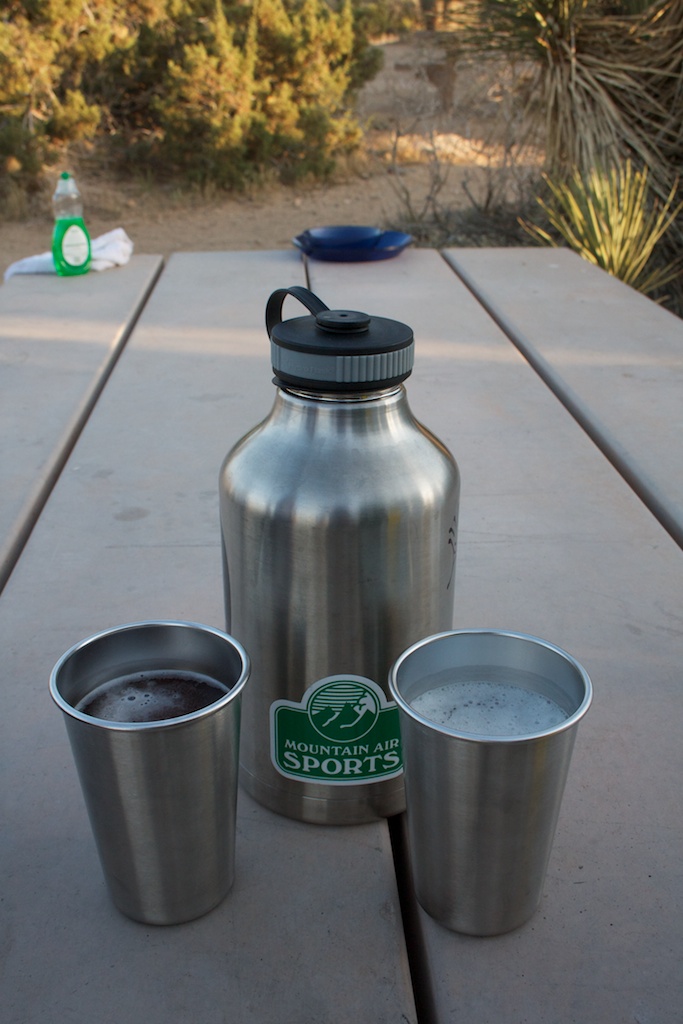
Growler and Pints at Joshua Tree
I’m sure many of you are like me and share a passion for both homebrew and camping.  The challenge, of course, is how to easily bring homebrew along with you when you’re in the great outdoors.  I have experimented with a range of options from bottles to traditional glass growlers in coolers all the way up to portable keg serving setups.  I’ll cover the keg options at a later time but right now I want to focus on what has been extremely easy and reliable for me recently.

Last year Hydroflask released a 64 ounce double walled stainless growler:

I got one right away and have been using it consistently for the last year and a half.  Overall I’ll say that while it’s not a cheap product I think it is well worth the money.

Right off the bat you’ll notice that your beer foams very little as you fill from your taps.  I have pretty well balanced draft lines so get little foam anyway but compared to glass growlers I notice this one has consistently much less foaming.  My guess is that it’s a combination of the stainless steel having little thermal mass and being polished extremely smooth so there are no nucleation sites.  In practice this means that I’m able to fill a growler right from the tap without having to use tubes, jockey down the pressure, or wait for the foam to subside.  I typically take around a minute to get a full 64 ounces.  The silicone o-ring sealed screw cap holds pressure well and is very easy to close.

So how does it do in terms of keeping the beer cold?  I’m sure you won’t believe me but I’ll say I’ve had numerous occasions where I had beer for 24+ hours in the growler without any kind of cooling and was able to pour it at near kegerator temperatures.  It’s good enough that on two separate Joshua Tree trips to the desert I haven’t even bothered putting the beer in a cooler.  Heading down to the homebrew shop or a club meeting is of course no challenge.

Is there anything I’d change about this growler?  Honestly the only thing is that it’s a bit pricey.  I’d love it if it was closer to $25 but I certainly don’t regret paying full price.  If mine were lost or stolen I’d replace it in a heartbeat.  I’m also thinking of getting a second so I can easily have a full gallon of beer with me.

The second half of the problem with taking homebrew camping is that you don’t have your favorite glasses to drink from.  I tried and compared two different options that attempt to fill this gap. The Silipint is a silicone drinking vessel in the shape of a traditional pint.  The benefits are that it is indestructible, relatively light weight, and moderately insulated.  On a cold night it’s nice to have your beer in a Silipint and not have to freeze your fingers.  I was worried about getting an off flavor or an odor from the silicone but after the first couple of washings it’s totally inert.  I have noticed that the silicone surface results in a lot of off gassing and a foamy pint.

The second choice, and my strong preference, is a new offering from Kleen Kanteen: the Stainless Steel Pint.  These light weight stainless steel pints are extremely durable.  While you might think you’d get a metallic flavor from the pint in fact it’s totally neutral.  In fact when compared side by side my homebrew tastes better from these than the Silipints.  I think the reason is that they are inert and pretty much get out of the way.  Their only downside is that on a cold night they can get your hand pretty cold.  They do help block any sunlight from skunking your beer, which is a plus.

If I were to buy again or recommend a solution to friends I’d go with the Kleen Kanteen Stainless Steel Pint. They are a solid choice at a good price and the beer tastes great.  Overall when you pair them with the Hydro Flask Insulated Stainless Steel Growler you can’t go wrong.  This is my go-to setup whether I’m heading to the beach, camping in the desert, or simply taking beer to share with friends.
Search for the Ideal Mash Tun

March 30th, 2012

I got a note from a visitor to the site who was curious about how my process has evolved:

One of your earlier blogs said you moved from your Blichmann 10 gallon mash tun to a simple Gott cooler and found the going easier.

What are you using these days and how would you describe the difference between the two?

– Cory

Well, Cory, this is something I’ve gone back and forth on a few times.  I will say that if you do single infusion mashes for 5-6 gallon batches then the Gott or Igloo cooler is a nearly ideal tun.  It has low thermal mass, holds temperature extremely well, is cheap and durable, and cleans up and packs away easily.  When I was batch or fly sparging this was my go-to vessel especially because I brew outside in the evenings and there can be a chilly breeze.

Well there is one major downside of the cooler that made me switch to a 15 gallon Blichmann mash tun for my 5 gallon batches.  I have switched to doing almost entirely no-sparge brewing (see my article in the November 2011 BYO Magazine) and a Gott cooler is really only good to about 1.040 gravity for six gallon batches.  Due to the way that the ratio of wort trapped in the grain versus runoff works even a few more gallons in capacity makes a huge difference.  A 15 gallon vessel is good up to around 1.080 gravity six gallon batches.  I tried other coolers but could never find anything that matched the perfect layout of the Gott so I bought a 15 gallon Blichmann Boilermaker.

This left me with the problem that caused me to leave the Blichmann mash tun in the first place: temperature drops.  Well since I started doing no-sparge brewing I ended up with significantly more thermal mass in the mash tun.  All the liquor goes in up front so everything is more stable.  I use a pump to constantly recirculate the wort during the mash but use direct fire on the mash tun itself to bump the temperature when needed.  I typically mash in at the desired temp and then check and direct-fire at 5 minutes, 10 minutes, 20 minutes, 30 minutes, and 45 minutes in the mash.  At a few of those points I stir a bit as well.  The burner is set very low so combined with the recirculation there is little risk of scorching.  Many of those times I’m just a degree or two low.  At the end of the mash I just redirect the pump to the boil kettle and I’m good to go.

I’ve also found that the stirring that goes along with this routine results in a more consistent efficiency, probably because the enzymes and starches are mixed up more evenly.  And of course I love the great features on the Blichmann including the laser etched sight gauge for the liquid level, the nice ball valve, the excellent false bottom, and the ease of cleaning stainless.  I really couldn’t be happier.

Well if all of this sounds like too much work (it isn’t really) then keep your eye out for a new toy from John Blichmann that will help with dialing in a consistent temp.  His new Tower of Power will recirculate the mash and kick on the burners when needed.  I’ll have a review of this on my site shortly after it’s released to the market as I won the first production unit in a raffle at NHC in San Diego.  He’s been delayed for a while in dealing with sourcing some of the more challenging electronics from overseas suppliers so I don’t have an ETA.

I hope that helps, Cory.


– Dave.

Blichmann QuickConnector Stainless Steel Fittings

February 14th, 2012

Over the years I’ve had a fleeting love affair with the idea of switching my homebrew setup to use all tri-clover fittings.  The theory is that doing so would ensure that there was not place for beer spoiling organisms to take hold on the cold side and ruin my beer.  Each time I dove in to plan out the changes I ran into two major problems.  The first was the obvious problem that switching over all my fittings would cost a princely sum.  Each hose would require two barbed tri-clover ends and each vessel or pump would need some as well.  My rough cost always penciled out to $250.

The less obvious issue was that since many of my components were threaded already (e.g. the March pump and ball valves on the Blichmann Boilermaker) then switching to a tri-clover fitting had minimal benefit.  The threads themselves potentially harbor the wort spoilers.  Threading a tri-clover fitting onto the existing components didn’t really improve the situation other than just looking cool.

So for a long time I simply used brass hydraulic hose quick disconnects (email me if you want more details.)  Well I ultimately decided to get rid of the brass but still stick with fittings that took minimal effort to connect and disconnect.  My first attempt was the original Blichmann quick disconnect fittings.  They did just fine but got too hot to touch when recirculating the mash or boiling wort.  Well John Blichmann once again read my mind when he improved his quick disconnect fittings.

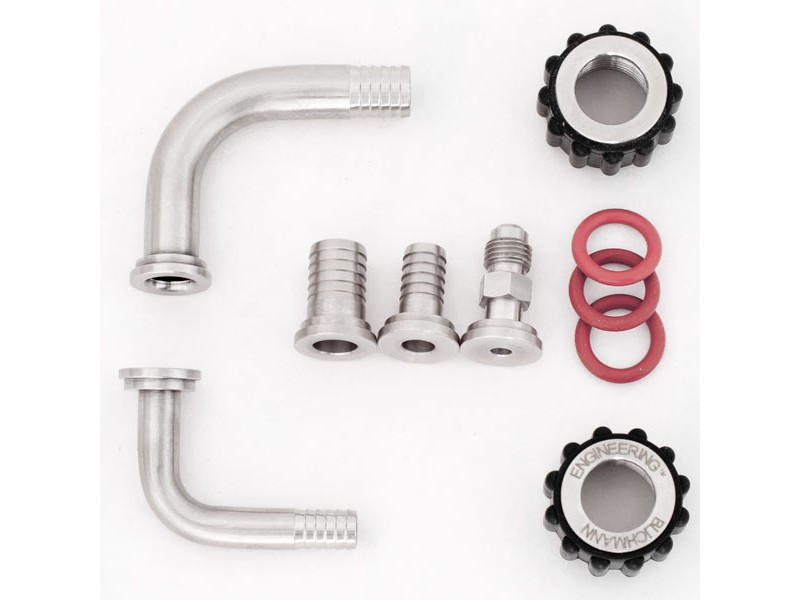
Recently Blichmann Engineering started offering the Blichmann QuickConnector Stainless Steel Fittings.  Basically they are silicone coated nut over various tail pieces to meet your needs:

Blichmann QuickConnector Stainless Steel Fittings

I swapped out all my brass quick disconnects to these because I have more confidence that heat will sanitize the tailpiece and silicone O-ring assembly compared to the brass quick disconnect.  Additionally the silicone ensures that I’m able to quickly switch my hoses without burning my fingers.

Compared to the previous quick disconnectors the obvious benefit is the silicone that makes it more comfortable to use with bare hands.  The less obvious change is that the silicone O-ring stays with the nut and tailpiece fitting much more solidly.  Previously I had to watch out for the O-ring falling out and had to store them separately.  Overall the new QuickConnector fittings are winners.

Getting back to the tri-clover fittings, given that I have to have threaded connectors on the cold side of my brew setup anyway the tri-clovers simply aren’t worth it.  If I were building a nano-brewery I’d weld in threadless fittings on each vessel and on the pumps but that’s not an option.  As a result the Blichmann connectors are the right balance of features for homebrewing.  My only reservation is that when you include the tailpieces they retail for around $15 a piece, which seems too steep to me.  I went ahead and plonked down the cash but honestly think that the right price point is closer to $10 for a pair.  Hopefully John will get to this point as he increases the scale of manufacturing.

Backing Out the Therminator

May 7th, 2011

Sometimes process changes aren’t for the better. This fall I made a bunch, starting with the Blichmann Hop Blocker. Then came competition brewing season and I didn’t have time to evaluate the results due to my frantic schedule (1-2 batches a week for three solid months.) The good news, though, is that I’ve now got lots of data both from the NHC feedback and my own testing and I’m going to make some changes.

The verdict? Not good. Several batches suffered from mild wild yeast infections. The judges didn’t always pick up the cause but when you taste them side by side it’s easy to pick up the problem. The other batches seemed to be lacking something that I couldn’t put my finger on. Not one batch was better than what I used to make before.

So, what did I change and what am I backing out? First, I started using the Blichmann Hop Blocker. It’s a great product that really helped prevent trub from reaching the fermenter. The problem, though, was that in the 10 gallon Blichmann Boilermaker my copper immersion chiller no longer fit. So I decided to change over to a Blichmann Therminator. Of course that meant a different setup for whirlpooling and sanitizing at the end of the boil.

Long story short, I tried several methods but ultimately about a quarter of my batches ended up infected in some way or another. The ones that weren’t infected seemed duller. I’m not 100% positive of the mechanism at work but suspect it has to do with letting the wort whirlpool and sit hot at the end of the boil. Why’d I do that? Otherwise the trub in solution at the end of the boil and hop pellet material would clog the Therminator. Ugh, what a mess.

Here were the downsides I found with my use of the Therminator:

  • Infections – despite back-flushing with hot PBW at the end of the brew day, circulating boiling water to sanitize before use, and attempts at autoclaving (which simply took too much effort to do regularly). I hadn’t had a problem with this before and the Therminator was the biggest change I’d made.
  • Added time – all the time I was spending trying to clean and sanitize the Therminator ultimately made my brew sessions longer.
  • Stuck Transfers – on two different hoppy batches I managed to clog up the Therminator completely meaning I couldn’t get all my wort into the fermenter.
  • Leaving the wort hot for longer – compared to an immersion chiller, which started dropping the temp of the whole batch right away, using the Therminator leaves wort at near boiling temp for longer. The Therminator was nice and fast but I had to do a hot whirlpool and let it settle for a total of about ten minutes before I could even start the draining.

Don’t get me wrong. I’m sure some folks are making great beer with this gadget but I’ve given up.

So I’m going back to an immersion chiller with a whirlpool. I’ll be brewing this weekend with this change in place and will post my results. The lesson here for me is to really take a more critical look at any changes I make to see if they’re really an improvement to the end product, the beer in the glass. And I need to do that well before competition brewing season. This year I’m going to use the summer for experimentation with process and I’m going to lock down all changes by October so I have time to let everything shake out before the winter brewing rush.

Happy brewing,
Dave.