September 27th, 2014
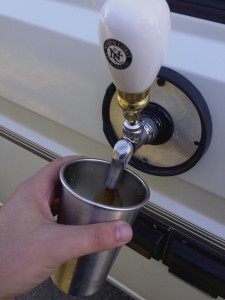 I should have posted this on my blog earlier. About a year ago I decided to rig up a draft setup in my 1988 VW Vanagon Westfalia van. Details can be found at http://www.thesamba.com/vw/forum/viewtopic.php?t=566037&postdays=0&postorder=asc&start=28.
July 22nd, 2012

Keep an eye on this space as I’ll soon be sharing some of the details of an Arduino based dual-stage multi-step fermentation controller project I’m working on. My goal is to make something brewers can put together for under $100 without skimping on functionality.
Dave
March 30th, 2012
I got a note from a visitor to the site who was curious about how my process has evolved:
One of your earlier blogs said you moved from your Blichmann 10 gallon mash tun to a simple Gott cooler and found the going easier.
What are you using these days and how would you describe the difference between the two?
– Cory
Well, Cory, this is something I’ve gone back and forth on a few times. I will say that if you do single infusion mashes for 5-6 gallon batches then the Gott or Igloo cooler is a nearly ideal tun. It has low thermal mass, holds temperature extremely well, is cheap and durable, and cleans up and packs away easily. When I was batch or fly sparging this was my go-to vessel especially because I brew outside in the evenings and there can be a chilly breeze.
Well there is one major downside of the cooler that made me switch to a 15 gallon Blichmann mash tun for my 5 gallon batches. I have switched to doing almost entirely no-sparge brewing (see my article in the November 2011 BYO Magazine) and a Gott cooler is really only good to about 1.040 gravity for six gallon batches. Due to the way that the ratio of wort trapped in the grain versus runoff works even a few more gallons in capacity makes a huge difference. A 15 gallon vessel is good up to around 1.080 gravity six gallon batches. I tried other coolers but could never find anything that matched the perfect layout of the Gott so I bought a 15 gallon Blichmann Boilermaker.
This left me with the problem that caused me to leave the Blichmann mash tun in the first place: temperature drops. Well since I started doing no-sparge brewing I ended up with significantly more thermal mass in the mash tun. All the liquor goes in up front so everything is more stable. I use a pump to constantly recirculate the wort during the mash but use direct fire on the mash tun itself to bump the temperature when needed. I typically mash in at the desired temp and then check and direct-fire at 5 minutes, 10 minutes, 20 minutes, 30 minutes, and 45 minutes in the mash. At a few of those points I stir a bit as well. The burner is set very low so combined with the recirculation there is little risk of scorching. Many of those times I’m just a degree or two low. At the end of the mash I just redirect the pump to the boil kettle and I’m good to go.
I’ve also found that the stirring that goes along with this routine results in a more consistent efficiency, probably because the enzymes and starches are mixed up more evenly. And of course I love the great features on the Blichmann including the laser etched sight gauge for the liquid level, the nice ball valve, the excellent false bottom, and the ease of cleaning stainless. I really couldn’t be happier.
Well if all of this sounds like too much work (it isn’t really) then keep your eye out for a new toy from John Blichmann that will help with dialing in a consistent temp. His new Tower of Power will recirculate the mash and kick on the burners when needed. I’ll have a review of this on my site shortly after it’s released to the market as I won the first production unit in a raffle at NHC in San Diego. He’s been delayed for a while in dealing with sourcing some of the more challenging electronics from overseas suppliers so I don’t have an ETA.
I hope that helps, Cory.
– Dave.
February 28th, 2012
It’s competition brewing season so I have gotten back into bottling beers instead of just kegging them. I also just made 10 gallons of single-decocted Bavarian Hefeweizen and put about half of it in flip top bottles to be a bit more traditional according to Stan Hieronymous’ Brewing With Wheat. One issue that always annoyed me was draining StarSan from bottles. It took a while to get the liquid out of the bottles and then I had to wait for the bubbles to subside or deal with foam coming out of the bottle.
Well recently I got the MoreBeer Counterflow Filler and watched the video by John Plise. In it he briefly mentioned a tip that I’d missed on previous viewings. When draining bottles rather than letting them glug and bubble straight out you can give them a quick swirl. A simple motion sets the sanitizer into a vortex in the bottle allowing air to come up the middle as the the liquid drains down the sides. The result is a much faster drain and significantly decreased bubbles in the bottle. All of this means that I can give up the bottle tree and just use a bucket with about three gallons of sanitizer during bottling. I invert the bottle, give it a swirl to set the vortex, and then wait a few seconds for the liquid to drain out.
May 12th, 2010
So after using An Analysis of Brewing Techniques to help answer a question that one of my homebrew club members had about fining, I decided to check Amazon to see what kind of reviews the book has received. To my shock I found a pair of low ratings from a decade ago that seem totally out of place. How could such a great book that’s cited numerous times in other homebrew texts and the BJCP study materials have a 2 1/2 star rating?
I’ve posted a review here: An Analysis of Brewing Techniques Review . If you don’t have this book see if you can track down a copy. If you do have this book I encourage you to post a review on Amazon to balance out the ones from so long ago. I’d love to see Brewer’s Publications revive this book for a new edition if possible.


Oh yeah, and sorry for not posting for a while ;). It’s been a busy year. Though just recently I had my Ordinary Bitter and Kölsch place in the first round of the NHC so they’ll be moving on to the big show. Both were recipes from Brewing Classic Styles: 80 Winning Recipes Anyone Can Brew with tweaks to match my process and with built water.
Happy brewing!
Dave.
